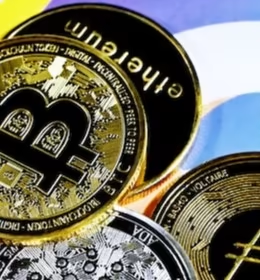
For over a decade, Bitcoin has been the undisputed king of cryptocurrency, synonymous with the very idea of digital money. But to look only at Bitcoin is to see a single star and miss the entire galaxy forming around it. Enter altcoins—the vast and varied universe of "alternative cryptocurrencies" that have risen to challenge, complement, and expand upon Bitcoin’s original vision. Their ascent marks a pivotal evolution in the blockchain narrative, moving from a singular store of value to a dynamic ecosystem of decentralised possibility.
The term "altcoin" encompasses everything that isn’t Bitcoin. Some, like Litecoin (created in 2011), were early forks aiming to be "silver to Bitcoin’s gold," offering faster transactions. Others emerged to solve perceived limitations. Ethereum’s 2015 launch was a paradigm shift, introducing smart contracts—self-executing code that birthed decentralised applications (dApps), decentralised finance (DeFi), and NFTs. Suddenly, blockchain wasn’t just for payments; it was a programmable world computer.
This innovation sparked an explosion. Thousands of altcoins now exist, each with a specialised niche:
Smart Contract Platforms: Challengers like Cardano, Solana, and Avalanche compete with Ethereum, promising greater scalability, speed, or energy efficiency.
Privacy Coins: Monero and Zcash focus on anonymity, offering fully obfuscated transactions.
Stablecoins: Tether (USDT) and USD Coin (USDC) peg their value to fiat currencies like the US dollar, providing a stable medium of exchange in a volatile market.
Meme Coins: Beginning as internet jokes, tokens like Dogecoin and Shiba Inu have shown the powerful role of community and culture, albeit with extreme volatility.
Utility & Governance Tokens: These provide access to specific network services or grant holders voting rights in a project’s future, embedding the community directly into the protocol.
So, why have altcoins risen to such prominence? The drivers are multifaceted. Firstly, they represent technological ambition. Developers are not satisfied with a single, monolithic design; they are experimenting with novel consensus mechanisms (like Proof-of-Stake), sharding, and layer-2 solutions to tackle the blockchain trilemma of security, scalability, and decentralisation.
Secondly, they fulfil diverse market needs. From artists minting NFTs to traders leveraging DeFi protocols for yield farming, altcoins provide the specialised tools for a new digital economy. They are the building blocks of a decentralised internet, or Web3.
However, navigating the altcoin universe requires cautious eyes wide open. The landscape is notoriously volatile and speculative. "Pump-and-dump" schemes and fraudulent projects abound, making rigorous research non-negotiable. Regulatory uncertainty also looms large, as governments worldwide grapple with how to classify and oversee these novel assets.
Looking Ahead: Integration, Not Just Competition
The narrative is no longer simply "Altcoins vs. Bitcoin." Instead, we see a maturing ecosystem where different chains serve different purposes, often interoperating. Bitcoin remains the flagship digital gold—a decentralised savings technology. Altcoins, meanwhile, are the engines of utility, powering everything from global finance to digital identity and supply chain management.
The rise of altcoins signifies blockchain’s journey from a fascinating experiment in monetary theory to a broad-based technological revolution. They are the testament to an open-source ethos of relentless innovation. For investors and enthusiasts, this expanding universe offers incredible opportunity but demands education, prudence, and a clear understanding that in this fast-moving galaxy, today’s shining star could be tomorrow’s supernova. The future likely belongs not to one coin to rule them all, but to a diverse, interconnected crypto-economy built on the unique strengths of many.